Tokyo Metro, Toei, and JR: How to Navigate Three Railway Systems with Line Codes and Exits
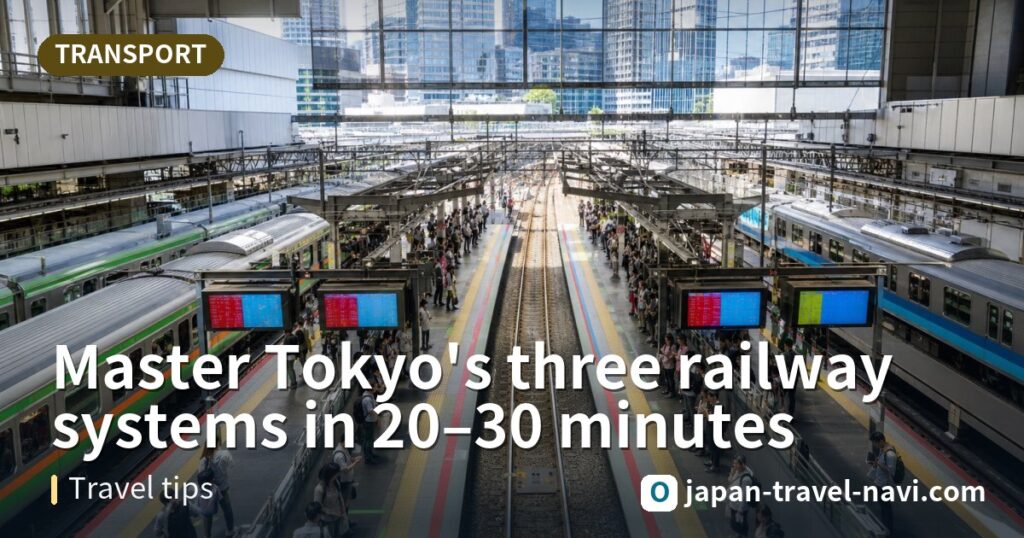
First-time visitors to Tokyo are advised to spend 20–30 minutes before departure getting familiar with how the three railway systems work. After that, you’ll navigate with confidence for the rest of your trip. During rush hour (roughly before and after the morning commute, and in the early evening), trains are crowded and transfer stations are enormous. If you’re carrying a lot of luggage, try to avoid these times and travel later in the morning or after the evening rush instead.
Contents
Understanding the three systems
JR East Japan operates the backbone network covering large distances. The loop-shaped Yamanote Line (山手線) connects major stations like Tokyo Station, Shinjuku, Shibuya, Ikebukuro, and Ueno, and is also commonly used for airport access and nearby areas. Tokyo Metro (東京メトロ) has 9 lines that weave densely through the city center, serving areas like Asakusa, Ginza, Omotesando, and Roppongi. Toei Subway (都営地下鉄) operates 4 lines; though fewer in number, these lines fill gaps not covered by Tokyo Metro.
Practical tip: use the JR Yamanote Line as your “backbone,” traveling between major stations; then switch to Tokyo Metro or Toei for shorter, detailed movements at the end. This approach requires fewer transfers than relying on metro lines throughout, and makes it easier to avoid getting lost.
Reading line codes and station numbers
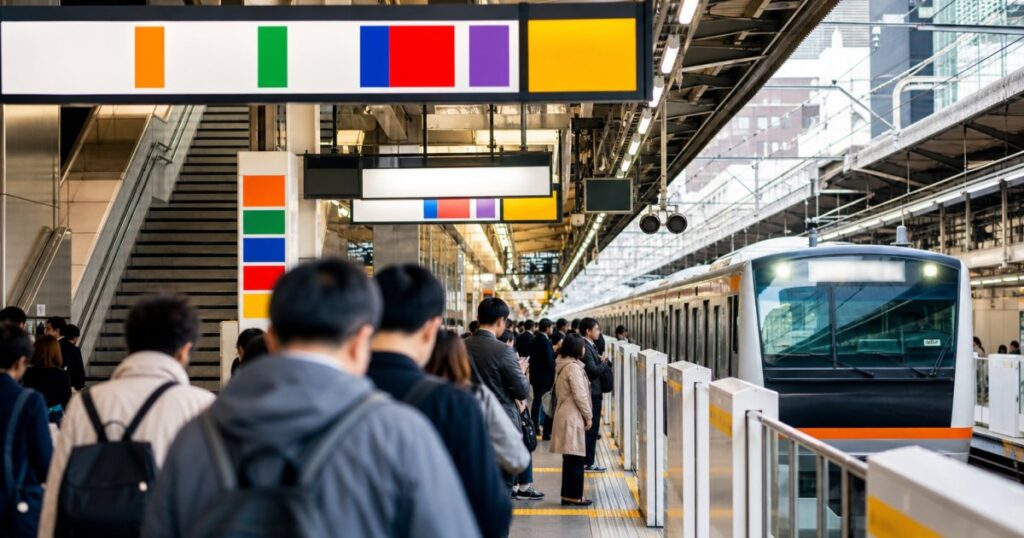
Every line in Tokyo has an English letter code, and each station has a two-digit station number—a combination like “letter + number.” When you see these markings, you’ll know which line you’re on and how many stops remain to your destination. Tokyo Metro and Toei typically use a single letter, while JR often uses two letters; the Yamanote Line is an example of the latter. Each line also has its own color, displayed on platform floors, pillars, and train exteriors, making them easy to identify visually.
Before your trip, save the “line letter + destination station number” for each journey on your phone’s notes app. While Chinese signage inside stations may not be complete, letters and numbers are always legible. If the station number is smaller or larger than your destination, you’ll know which direction to head on the platform.
Transfers and exit navigation
Transfers within the same company usually don’t require exiting the fare gate (改札口); between different companies, some stations require you to exit and re-enter, while others have dedicated transfer corridors. When transferring, look for the yellow sign showing the line letter and color, and follow it. If you use an IC card like Suica or PASMO, the system automatically calculates fares across different companies—no need to do the math yourself.
Before exiting the station, confirm the exit number (like A1 or B3) corresponding to your destination. At large stations like Shinjuku, Shibuya, and Tokyo Station, different exits can mean 10+ minutes of extra walking. If you pick the wrong exit, don’t rush outside—going back and taking another exit from inside the station is usually faster.
Using an app to check routes
Use a map or transit search app: enter your starting point and destination, set your departure time, then compare results for “fastest” and “fewest transfers.” When traveling with children or large luggage, the fewest transfers is usually less exhausting.
Check four things in the search results: which line to take, which direction (final destination), platform number, and exit number. The timing of the last train of the day is also shown; check this before evening dining to avoid missing the final service. If the app shows “rapid” (快速) or “limited express” (特急), confirm that the train stops at your destination before boarding.
Traffic and itinerary reminders
- Have an IC card (like Suica or PASMO) ready on your phone wallet or as a physical card before you go. No need to buy individual tickets for each journey or transfer. Check official sources for the latest fares and ticket options before you depart.
- Avoid peak commute hours. Travelers with large luggage should consider departing later in the morning and always use exits with elevators. Elevator locations at major stations are shown in station maps within apps or posted at the station.
- Before boarding, confirm the train type and final destination displayed on the platform. For lines like the Yamanote Line, distinguish between inbound (内回) and outbound (外回) directions. If you board the wrong direction, simply exit at the next stop and cross to the opposite platform.
- When planning a day’s itinerary, allow buffer time for each transfer. Major station transfers typically need about 10 minutes; don’t schedule activities back-to-back.
- Last train times vary by line. Check your return route’s final departure time in the evening and have a taxi backup plan ready.
- If a line stops or is delayed, immediately reopen the app to find an alternative route, or switch to another company’s line to bypass the problem. This is usually faster than waiting at the platform.
This article was prepared by the Japan Travel Navi editorial team. Station and transit information may change; please check official updates from each facility and operator before you depart.
Please refer to the latest official announcements for current conditions.
This article was translated from our Traditional Chinese edition.
Related reading
 Kyoto by foot, bike, and taxi: how to combine them for the best use of time and energy
 Getting to Arashiyama: Comparing JR, Randen, and Hankyu Transit Options
 How to Get from Kansai Airport to Kyoto: Express Trains, Buses, Late Arrivals & Return Options
 Kyoto Metro, JR, Keihan & Hankyu: Complete Transit Guide to Skip Bus Traffic
More from Tokyo
More Christmas Shopping Pop-up at Ichigaya Station (Toei Shinjuku Line) Nov 25–Dec 26
 Nov 22: 20th Bakuretsu Festival – Airsoft & Tactical Gear Showcase
 Nov 28–29 Ikebukuro Sunshine City Furniture Clearance Sale – Free Entry
 Marunouchi Building’s RIMTAE Debuts Black Tea Blooming Tea with Peony and Chrysanthemum