A Perfect Half-Day Walk Along Nakanoshima River: Modern Architecture, Roses, and Museums
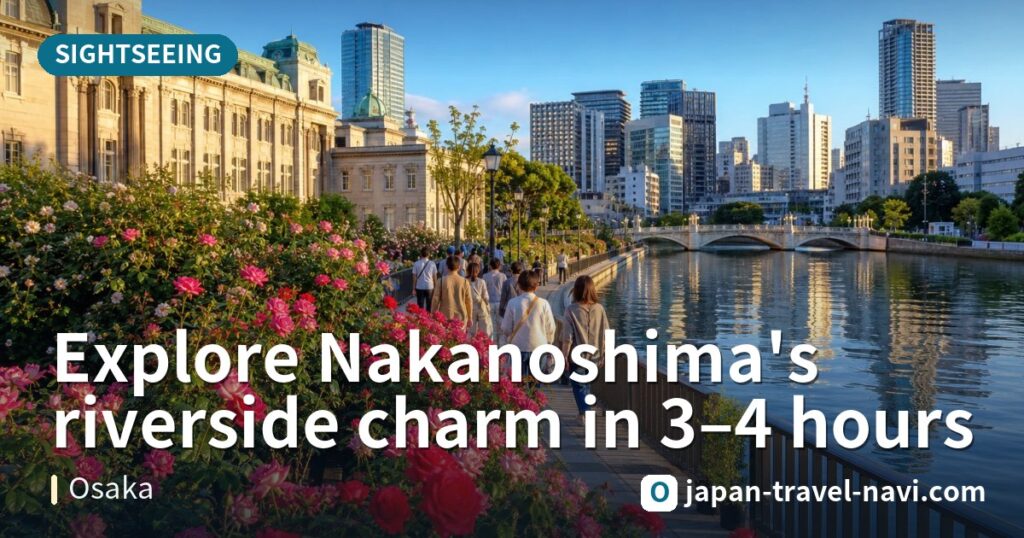
If you enjoy a slow pace, taking photos, and browsing exhibitions, Nakanoshima is worth adding to your Osaka itinerary. Plan for half a day—about 3 to 4 hours—from morning through early evening. If winter illuminations are on your radar, time your visit accordingly to finish before dusk.
Contents
- How to structure the route: Walk west from Yodoyabashi Station
- Modern architecture: Photograph exteriors first, then pick one to enter
- Rose season: Weather matters more than the calendar
- Museum lineup: Pick one or two, not all
- Winter illuminations: Time it around sunset, walk the route in reverse
- Transportation and planning tips
How to structure the route: Walk west from Yodoyabashi Station
Start from Yodoyabashi Station and head west along the riverbank. It’s just one stop on the Midosuji Line from Umeda, and direct from Namba with no transfers needed. Walking in this direction, you’ll encounter modern buildings, riverside parks, and museums in sequence—no backtracking required.
Begin by viewing the distinctive stone exterior of the Bank of Japan Osaka Branch (日本銀行大阪支店) near Yodoyabashi, then walk to the Osaka Prefectural Library (大阪府立中之島図書館), and finally reach Osaka City Central Public Hall (大阪市中央公会堂). All three have striking exteriors and deserve about 15–20 minutes each—you don’t need to go inside every one. Interior access and tours vary; check official information before you go.
Modern architecture: Photograph exteriors first, then pick one to enter
Central Public Hall, with its red brick and stone façade, is the most photogenic. Stand on the opposite bank or on a bridge to capture its full elevation. Morning light is softer and crowds are thinner, making it ideal to start here.
If you choose to enter just one building, select either the Public Hall or the Library depending on whether they’re open that day. On rainy days, focus on the museum interiors; shorten the riverbank segment and move under eaves and underground passages instead.
Rose season: Weather matters more than the calendar
The Nakanoshima Rose Garden (中之島公園バラ園) within Nakanoshima Park is the highlight of this route. Spring roses typically bloom around May; autumn blooms run from late October through November. Peak bloom shifts yearly depending on temperature, so check official updates before your visit.
View roses before noon for the best light and to avoid overexposed photos. Holiday afternoons draw large crowds; consider visiting the museum first and returning to the riverbank at dusk instead. If you’d rather avoid the flower throngs, head to Naniwa Bridge to see its lion sculptures, then backtrack to photograph the rose garden and the opposite shore.
Museum lineup: Pick one or two, not all
Several major museums line the riverbank: the Osaka Museum of Oriental Ceramics (大阪市立東洋陶磁美術館), the Nakanoshima Museum of Art (大阪中之島美術館), and the National Museum of Art (国立国際美術館). Each requires substantial time; plan for one or two only. Prefer classical crafts? Go for the ceramics museum. More into modern design and contemporary art? Head west to the other two.
Check exhibitions and closures in advance, then plan your order accordingly. If you want to catch the illuminations in late afternoon, schedule museums for midday and emerge just as sunset light bathes the riverbank. Museums usually have seating, so you can rest and avoid the hottest or coldest hours outdoors.
Winter illuminations: Time it around sunset, walk the route in reverse
Winter illuminations come alive after dark, highlighting the riverbank and building projections. Days are short; plan to arrive around 4 p.m., photograph buildings while light remains, then watch the lights unfold. Event dates, lighting times, and layouts change yearly—check official announcements.
Evening riverside winds can bite; bring gloves and a scarf. On crowded days, scout good vantage points on bridges first, then drift downstream gradually rather than jostling in the park center. After the show, nearby stations—Kitahama, Oebashi, or Yodoyabashi—make it easy to return to Umeda or Namba.
Transportation and planning tips
- Getting there: Rely on trains and subway. Yodoyabashi, Kitahama, Oebashi, and Higo-bashi stations all serve the riverbank. Use the “enter at one station, exit at another” strategy to avoid retracing steps.
- Walking time: The full route takes 40–60 minutes at a brisk pace. Add photo stops, museum visits, and rest breaks—budget 3–4 hours total. Wear comfortable shoes; while the riverbank is mostly flat, stone paths and bridges can tire your feet over time.
- Parking: Street parking near the city center is scarce. Don’t rely on driving. If visiting from elsewhere, park at the city’s edge and switch to trains.
- Timing adjustments: Schedule rose viewing for the morning, illuminations for dusk. Use museums as a comfortable indoor “buffer” in the middle of your day. If weather turns bad, pivot to museum-focused itineraries.
- Safety: Riverside winds are strong at night and lighting is dim. With children or elderly visitors, stick to well-lit main paths and avoid leaning near railings for photos.
- Confirm beforehand: Exhibition dates, closures, rose conditions, and illumination schedules shift yearly. Check official websites and announcements before departing.
This article was written by the Japan Free Travel Information Station editorial team. Attraction and transportation details may change; please verify with facilities and official announcements before your visit.
Always follow the latest official information for current conditions.
This article was translated from our Traditional Chinese edition.